
A long-awaited breakup confirmed.
Mariameno Kapa-Kingi leaves Te Pāti Māori, this time on her terms.

I’ve mentioned across a few blogs over the last six months about the internal discontent in Te Pāti Māori. Today, the splinters became permanent.
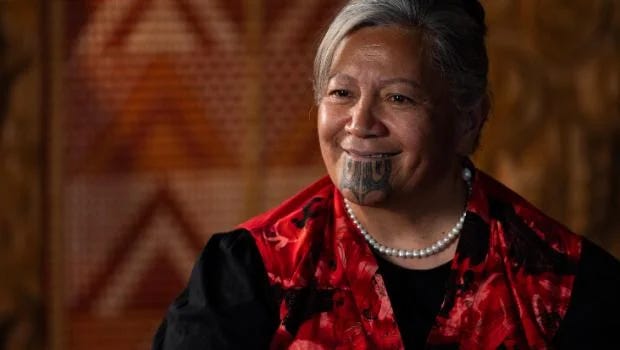
In an interview with The Hui released this morning, current Te Pāti Māori MP Mariameno Kapa-Kingi announced that she would be leaving TPM and starting her own political party centred around her Northland electorate Te Tai Tokerau. Let’s talk about why, learn a short history of MPs starting new parties and why it all matters.
WHY IS SHE DOING THIS?
Last year Kapa-Kingi, along with Te Tai Tonga MP Tākuta Ferris were expelled from Te Pāti Māori after discontent between them and the party leadership, particularly party president and lead strategist John Tamihere.
Earlier this year, Kapa-Kingi took TPM to court and won a case which ruled her expulsion to be unlawful because it was not executed in line with the party’s own constitution. In the wake of this, her membership was reinstated and she made a series of requests including that Tamihere resign, and that Ferris also be reinstated as a party member.
But in interviews since she was upfront that she had had little contact with the party leaders, hadn’t been invited back to caucus and Kapa-Kingi and Ferris have been sharing an office separate to the other four TPM MPs. It was clear that something was going to happen and much speculation was swirling that both rogue MPs would likely run as independents at this year’s election.
Today’s announcement confirmed that for Kapa-Kingi, and she indicated in her interview that it is likely more MPs will follow a similar path.
WHAT’S THE DEAL WITH THE NEW PARTY?
Great question, and there is much still to be discovered but there were some interesting tid-bits in the interview. Firstly, it is a local party specifically focused on the Te Tai Tokerau region and NOT a national party.
This is a pretty unique arrangement, but she did confirm that it won’t just be Kapa-Kingi running for election and she thinks “we have to” have candidates in general seats as well (Te Tai Tokerau is the Māori seat which covers the whole of Northland).
While she outlined some vague principles and kaupapa in the interview, Kapa-Kingi didn’t immediately differentiate herself with any policy indicators, so I suppose that’s all yet to be seen.
She did hint that if other MPs take a similar route, she would be keen to work with them as a “network” of independent, localised parties rather than forming one big party machinery.
Interestingly, she also said she would be willing to work with National and that those were “discussions to be had after the election”. Indicating a much more pragmatic approach than her former party.
WILL IT WORK?
Most recent history gives a mixed tale. Back in 2011, legendary activist and, at the time, two term MP Hone Harawira was expelled from The Māori Party and resigned from Parliament causing a by-election in this very same Māori seat, Te Tai Tokerau. He did win the by-election under his new “Mana Party”, but three years later neither he nor Mana were re-elected after forming an unlikely partnership with Kim Dotcom’s Internet Party.
Harawira first entered parliament in 2005, as part of the New Māori Party which was formed when Tariana Turia resigned from the Labour Party over the Foreshore and Seabed Contraversy. Turia won the by-election to retain her seat in 2004 and in 2005 the new party brought home 4 of the Māori seats and, aside from one blip in 2017-2020, has been in parliament ever since.
Going back a little further in history, back in 1993 a fiery National MP named Winston Peters resigned from his party after disagreements over policy (and because he wanted to be Finance Minister) sparking a by-election which he won with a 90% majority, Less than 6 months later his newly formed New Zealand First Party won two seats, his and Tau Henare in what was then the “Northern Māori” seat- the same arena of Northland once again. 3 years later they won all 5 (at the time) Māori seats, plus Tauranga and took home 13% of the vote in our very first MMP election. The rest, is indeed, history.
That past tends to indicate that Kapa-Kingi has a very good chance of winning her electorate, but the localised approach of “the party” is new territory which will be fascinating to watch unfold.
THIS IS JUST THE BEGINNING
It’s likely that Kapa-Kingi’s fellow expelled colleague Tākuta Ferris will also run as an independent, or perhaps now with his own South Island-focussed party in a similar vein.
That is something which I think would be much more interesting, because of the large land area covered by the Te Tai Tonga electorate. The electorate he currently holds covers the entire South Island, Wellington City, Stewart island and the Chathams, all-in-all covering nearly 30 general seats. A party decade to the South alongside Ferris’ campaign would be a much larger-scale operation, but one that definitely has some votes in it.
Stuff reported today that Oriini Kaipara is also not committed to running for TPM, while Some media are also reporting that TPM rising star Hana-Rawhiti Maipi-Clarke is “considering her future”. She has undeniable public following and star power, and if she leaves Te Pāti Māori that could push the permanent splinter, into more of an existential crisis.
WHY DOES IT MATTER?
You might be thinking…Austin this is all just a sideshow surely? TPM are sitting at 2% in the polls. They aren’t going to decide the election. Well….actually they might.
Annoyingly, the reason why is not that simple because it has to do with an MMP quirk called “overhang seats”. If this is new to you, bare with me. It’s a bit technical, but fascinating.
Overhang seats occur when a party wins more electorate seats than their share of the party vote. In the 2023 election Te Pāti Māori garnered 3.08% of the vote, which won them 4 seats in Parliament (out of a usual 120 seats). BUT, they won 6 of the 7 Māori seats. So they won 2 more seats than their share of the party vote allowed.
When this happens, to keep things fair, 2 seats are added to Parliament. So we currently have 122 MPs instead of the usual 120. To govern a majority of 62 is then needed, instead of 61, and Te Pāti Māori get to keep all 6 of their MPs.
If that seems a tad confusing, be grateful we aren’t in Germany. The German Parliament (Bundestag) has 598 seats, so they often get huge numbers of overhangs, which they then compensate other parties for by gifting them extra list seats until proportions are correct with the party vote. In 2021, they had 138 EXTRA seats in parliament because of overhangs, and compensation seats awarded. Wild stuff, thank goodness we have a small parliament.
Importantly, in a close election like this year is shaping up to be- these overhang seats could be the difference between who forms a government. Allow me to illustrate (blimey, we’re down the wormhole now but you’re leaving this with a Bachelor’s degree understanding of MMP. Your certificate will be in the mail!).
In this scenario the party votes are as follows (and not far away from current polling trends it has to be said):
LABOUR- 37%
NATIONAL- 30%
NZ FIRST- 12%
GREEN- 8%
ACT- 7%
TPM- 2%
OTHERS- 4%
Now we compare two scenarios where the party vote is the same. In scenario one, TPM retains the 6 electorate seats they currently hold. In scenario two, they retain just two electorate seats.
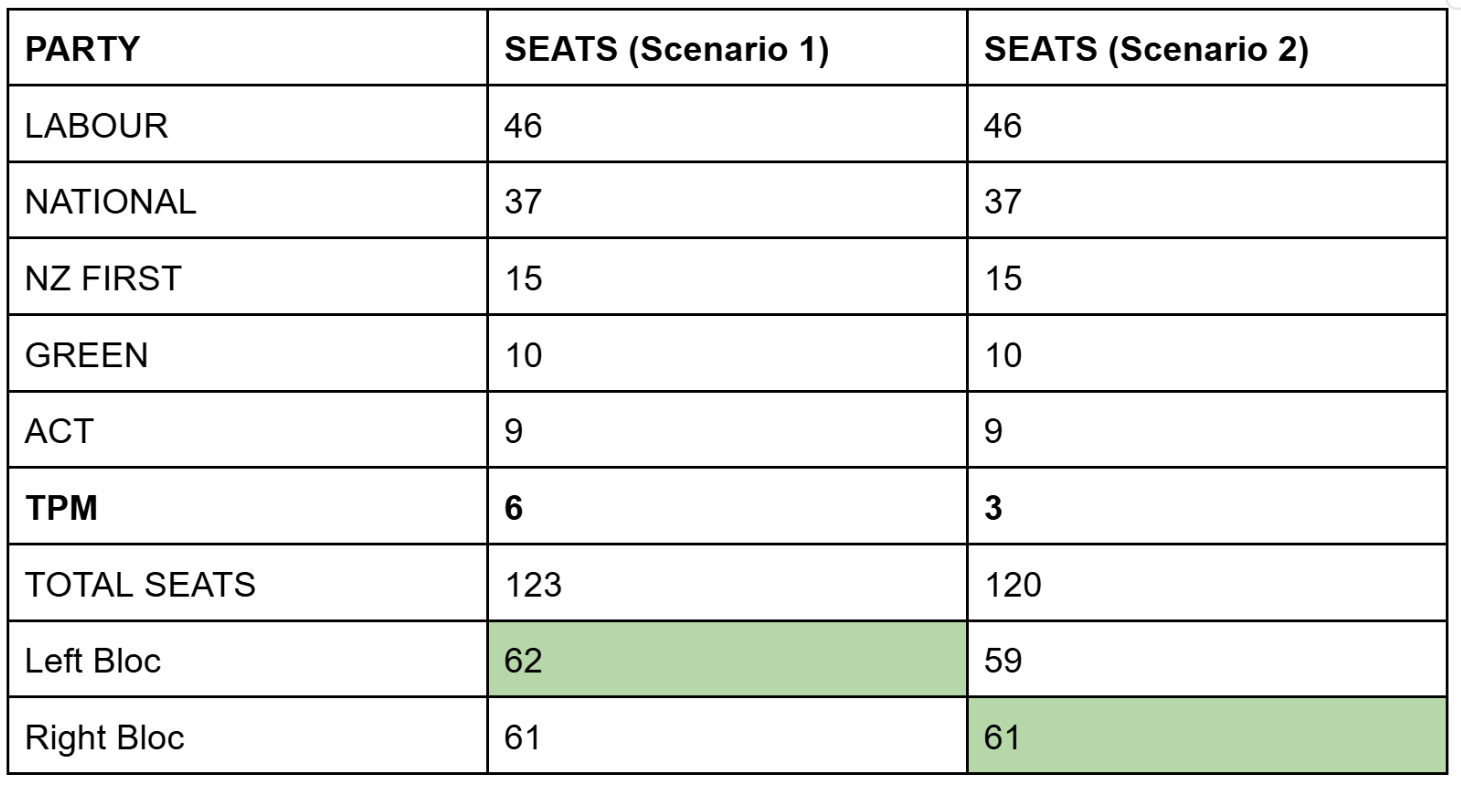
As you can see, in scenario one TPM generates 3 overhang seats and the left bloc has 62 seats- enough to govern. In scenario two, there are no overhangs and the right bloc (current coalition) has 61 seats which is enough for a majority.
So these seats, the overhangs and most importantly the Māori electorates can be THE deciding factor in an election. Today’s splintering muddies these waters even further with potential floating independent MPs to factor in as well.
CONCLUSION
This little sideshow could well make or break the election this year, but one thing is clear. The best scenario for the left bloc would be for TPM to stick together and win as many electorates as possible, with a small party vote. Labour too should be letting that happen. It’s obvious which side of the aisle benefits from this overhang business.
Another thing is also clear, that is absolutely not what’s going to happen.